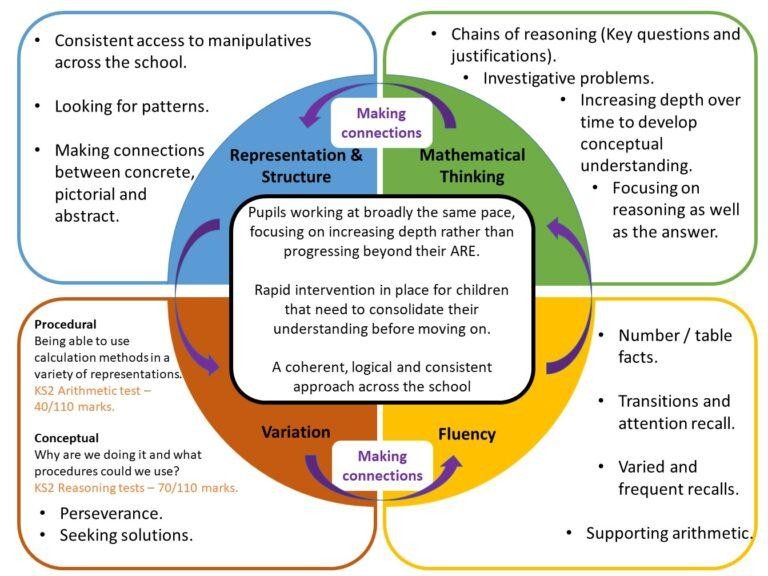
At Roche CP School we are in the ‘Sustaining’ phase of our Mastery Maths journey which we have fully embraced since 2017. We cover the scope of the 3 main aims of the National Curriculum (Fluency, Problem Solving and Reasoning) using NCETM’s ‘5 big ideas in teaching for mastery’ (See diagram below).
We want our children to be fluent in the fundamentals of Mathematics. We believe if children can manipulate numbers confidently, accurately, efficiently and flexibly they will then be able to develop their problem solving and reasoning skills successfully.
We have spent time researching and creating our own Maths Policies that put the National Curriculum objectives into blocks:
These are then sequenced to allow children to make connections between their work. This sequenced order is highlighted in our Maths books, showing a clear story of the children’s Maths journeys within an area of Maths, for example, the story of Place Value. This will help children with both conceptual and procedural understanding. We break new maths objectives down into small steps. This allows children to gain a deeper understanding of Maths concepts.
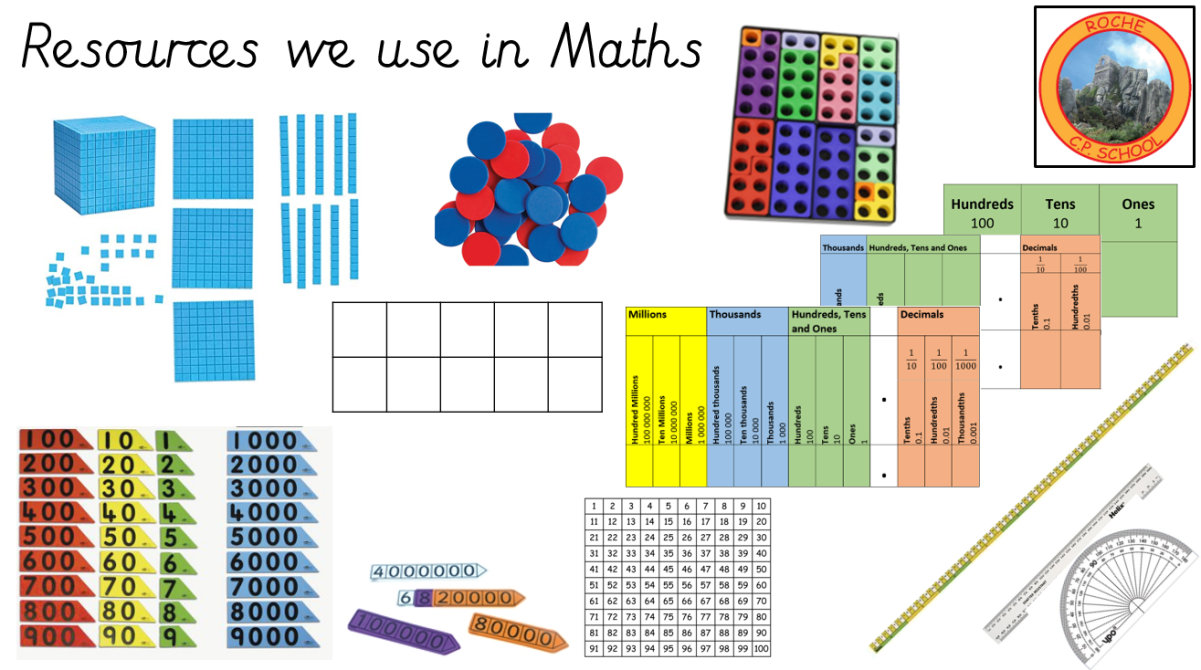
We have also designed our own Written Method Calculation Policy. This policy provides a consistent progression of skills across year groups so that methods build on pupils’ prior learning. Alongside this we have carefully selected practical manipulatives that promote Mathematical understanding. These are used consistently from EYFS to Year 6 (where needed).
Due to our Maths Curriculum being delivered in a linear approach, we revisit key areas that are identified through diagnostic assessment. These are revisited twice a week. This enables us firstly, to address and consolidate gaps and secondly, where appropriate, we carry out out further pre-assessment tasks which will support main Maths lessons in the future.
We ‘linger longer’ on certain areas of maths (Place Value, 4 Operations and Fractions) so our children experience variation, depth and breadth within their year group for these significant areas. We aim for them to confidently apply both their declarative and procedural knowledge to problem solving and reasoning. Through this approach, children’s knowledge is deeply embedded and within their long term memories. This then prepares them to be confidently ready for their next stage of Mathematical learning.
Multiplication Tables Check
The results for MTC for 2025/26 were above national average.
Our strategy document for MTC and for Declarative knowledge are attached below.
EYFS Maths
We have developed and use our own EYFS Maths policy to support the whole class direct teaching of Maths as well as Continuous Provision linked activities each day. Number is the key priority, with an emphasis on Place Value and Counting.
EYFS Maths follows a mastery approach: Practical, Pictorial, Abstract (this supports varied fluency) as well as promoting problem-solving and reasoning.
Research has been carried out into the 6 main areas that collectively underpin children’s early mathematical learning, and which provide the firm foundations for the Maths that children will encounter as they go up the years in primary school:
Cardinality and Counting
Comparison
Composition
Pattern
Shape and Space
Measures
Time is dedicated to learning a number deeply over 2 weeks up to the number 10. This will heavily support the first 4 main areas for developing children’s early Mathematics.
Children receive a 30-minute Maths lesson 5 days a week that is then always reflected in their Continuous Provision to allow children to keep rehearsing and practising these vital skills to help them become fluent and for it to be embedded in their long term memory.
Mastering Number NCETM
Mastering Number is a series of short maths sessions done in addition to the main maths lesson in Reception and key stage one and two. The aim of the programme is to ensure that all pupils have a firm understanding of number, including subitising, cardinality and counting. This is continued in to key stage 2.
Mastering Number lessons take place in addition to the daily maths lesson.
Mathematical Vocabulary
There is a strong emphasis on the use of correct mathematical vocabulary. This focus stems from the reading Comprehension strategy. Good understanding of maths vocabulary enables children to solve problems, explain reasoning and reduces cognitive load.
An example of vocabulary for Place value is attached below. Vocabulary is on display in all classrooms on the maths working wall.